Thursday, 9 May 2013

What character models guide narrative best? Do we want role models or blank canvasses?


For all my talk of emergent narrative and it's wondrous effects on games, I haven't really covered the core promoter of it:- The player character. Even in board games they are the most important piece of the puzzle as they are what the player uses to identify themselves in the game world, to find their place if you will.

In my humblest of opinions there are two main types of character for the player to control. The role model and the blank slate.

The Role Model 
This is the character that has his or her own opinion and likes to let it be known. This type of character might be able to affect the player, to push his/her decisions by either their own force of personality or by suggesting their opinion to the player at a key decision making moment of the game. They still allow the player freedom to decide their own way through a story, but exist to help push the story along the 'right' path.

The Blank Slate
This character is the epitome of a player 'doll'. In extreme cases nothing about them is defined before the player gets their hands on them, in moderate cases they are merely vestiges through which the player becomes a living resident of the game world. Blank slates give the player total unhinged freedom to take the game's story along the path they desire (obviously within the scope that the designer has set out for them).

Both types of character have their benefits - the role model provides for an easier tied together story as there is one more (major) acting in every scene, whilst blank slates give the player a larger amount of perceived freedom, and in turn give them a greater sense of personal investment. The question posed however is do we as gamers want one over the other? I don't feel like that's a question that I have the authority to answer. But if I were to impose my opinion on the subject well... I like blank slates, I like to believe I'm a living, breathing, walking, talking person in the fantastic worlds set before me.

What do you like? 

Board Games vs Video Games, is there a preferred medium for emergent narrative?


Carrying on from the last post's broadcast, emergent narrative is quite an interesting theme isn't it? I think so at least. It's a very interesting narrative technique that is almost unique to games (alternates would be create your own adventure books and that short stint I think they tried with T.V that would let you vote on how the story would continue? That may have been something I dreamed up I'm not sure).

Anyway, another medium I get a great amount of enjoyment is boardgames, so I got to thinking - with all the local social elements that feed into any good board game, do they make for a better platform for emergent narrative? At face value each medium has it's pros and cons. Lets have a look at them. (Keep in mind due to the wide variety of both computer and board games, obviously these examples don't apply to everything).

Choice making: At it's core, emergent narrative is all about giving the player choice, and making that choice affect the story later on. This is also a fairly core rule in many boardgames as many a time the players are simply given a backstory, or a fairly brief overarching story and are given the initiative to move on past it (strong example here is Arkham Horror, a game where players must team up to overcome lovecraftian horrors). Often though in these games a random element can come into play which will interrupt the player led story and take it in new directions, while this could be argued to be some equivalent of a computer system driving the players forward, the random nature of it I feel detracts from the structure. The equivalent in games would be as earlier discussed - choices made either in dialogue or through actions that drive the story forward, these feature a less random, more structured approach however.

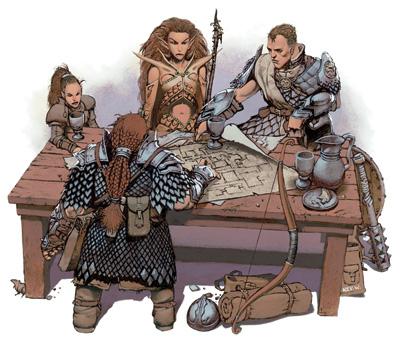
Social: A fickle one depending on who you're playing with. In computer games adding a social (by social I don't mean facebook integration) aspect can really help players come together to shape the world - this is usually limited to MMOs, though it can also show in more casual games. Typically this would show itself as a group, probably a large group at that, reacting to a world event that would change the world depending on the outcome. In boardgames this is much more organised - particularly in tabletop games such as Dungeons and Dragons or war games like Warhammer 40k. In DnD the players form a small band of adventurers that react to the game masters instructions and try to impose their own will upon the world outside of his/her plans, more often than not leaving those plans in ruins and forging an entirely new world out of it. In 40k there have been massive tournaments between editions that result in potentially huge changes to the entire universe.

There's many more sides to discuss here, but I feel these two main focii represent the discussion fairly well. While one medium might provide stronger motivation in some regards, the other medium will pick up in others. Both medium are fairly efficient at providing emergent narrative for the players and neither really outshine the other properly, at least not just now... God it's horrible sitting on the fence.

Is player lead narrative a good thing? And who cares?


Yes, and I do.

...Guess I should elaborate. Player lead narrative, more commonly referenced as emergent gameplay is giving the player the power to direct the story in which ever way they see fit (limitations obviously apply within the scope of the game). This can be achieved in a number of ways which provide a variety of levels of control and flexibility, as well as certain methods being easier to implement than others.

Perhaps the simplest method of implementing emergent narrative is multiple choices in dialogue. Simple text triggers that can further down the line create diverging paths in the story. This is a fairly common method of emergent narrative due to it's simplicity and flexibility - the amount of power the player has to control the story is completely up to the designer, every possible choice the player can make has been thought out already and is accounted for. This kind of choice based control is commonly seen across all genres, though I believe we most often see it in Action/Adventure games or RPGs, particularly in games with lighter stories. Examples of this would be DragonAge and Planescape: Torment.


A slightly more advanced version of this would be player investment. This requires a character that grows stronger over the course of the game, and allows for the player to choose what areas they grow in. This is basically hiding or greying out certain choices to the player in dialogue or action sequences unless they have a certain aptitude in a skill (For example, when talking with someone unless the character is particularly skilled in the arts of persuasion they wouldn't be able to get good information). This method is effective but unfortunately can prove to be exclusive - if the player wishes to see all or most of the game presented to them they are more often than not forced to build their character in a certain way (Brains over Brawn). Examples of this are the Mass Effect Series and the old Fallout games.

The last method I'll discuss, which I'm not overly fond of because it's so often done poorly is Quick Time Events. When done right QTEs can be a pretty powerful tool in helping the player direct their own story. For example giving them the choice to go left or right on a road, and a few seconds to make that choice - enough time to make an informed decision on which way they want to take the story, but not enough to probably ponder over it's ramifications. The unfortunately reality of QTEs are that they are misused in games more often than not, and a QTE choice in game will often be a case of dodge NOW... Game Over.

Emergent narrative can be a strong tool in the designers retinue. When used right it is one of the most effective tools in empowering the player's ability to imprint their self onto the gameworld as they can actually see the world reacting to their decisions. It really is a good device, and whilst it's being used to great ends in some areas I still see far too many cases of it being mishandled. It's a pretty big shame really.

Wednesday, 8 May 2013

What drives a good narrative?


Good question that, and one which has more than one potential answer:- perhaps it's allowing for a large amount of player expression, maybe it's strong characters, mayhaps it's following a strong storytelling formula, or perhaps even just maybe it's putting the right amount of tragedy in the right place at the right time. The common factor in all these answers is that they all expect and empower the player to care about the game world or the character they are controlling.

Without this sense of care from the player, you could write the best story in the world but it would still fall flat on it's face because the player doesn't care and thus can't identify with the story - it becomes meaningless to them. Many times have I sat at a friend's house and watched as they thoroughly enjoy the game they are playing, but then proceed to skip every cutscene they come across and speed through every bit of dialogue as if it were in the way of their enjoyment. Heck I've been caught doing this myself, 9 times out of 10 it was because neither myself nor my friends cared about what was going on in the story - we just wanted to play the game. To this end, at least for personal reflection's sake, it might be a good idea to think of this in terms of what could motivate the player to care about their character, the game world and everything in it.

Two possible motivations on this thought would be that of self preservation and providing a strong player identity within the game world itself. Self preservation largely concerns a more ludological approach to tieing the player together with the story - through their own desire to keep their character alive they develop some sort of identity with that character, acting as if that character has become some part of their self. This motivation can become very strong if the difficulty of the game is just right - too easy and the sense of preservation is lost due to there being no challenge to speak of, too hard and the preservation takes effect but diminishes as the player gets more and more frustrated.

Providing a strong player identity can also drive a strong narrative, though this is unfortunately situationally effective depending on the type of player. There are multiple ways to go about this, and when done right it can provide incredible potential to immerse the player in the game as they are presented with a medium through which to imprint their own method or madness upon the gameworld.

What genres benefit most from a strong narrative?


As earlier mentioned, narrative holds a key point in every great game. However the extent of this effect can be limited depending on the game genre it is evident in, an extreme example of this would be comparing the narrative effects evident in an RPG as opposed to a Puzzle game. Here's a rundown on my thoughts on each genre.

RPG
If I had to define one reason why narrative must exist in games today, it would be RPGs - they simply would not exist if story were to never meet gameplay. With such rich examples of storytelling in this genre from both jRPGs in the East and cRPGs in the West it's hard to imagine a game being released in this genre that doesn't lead with a strong sense of story.


Action/Adventure
The Action/Adventure genre as I see it encompasses everything from platformers to RPG-lite point and click adventures to high fueled, explosive action sequenced games. Despite this massive array of games, it's quite easy to see at a glance that action/adventure relies heavily on a strong narrative. I'm hesitant to say it is as much reliant as RPGs are as if you take away the narrative you'd still have a fun game seven times out of ten, probably not true of RPGs - but it's certainly up there. A detail I feel that is important to note is that many of these games are single player, especially coming into modern days with the likes of Uncharted or Mario Galaxy. And, as noted before, without a competitive human aspect there is only the story and the challenge to drive the player on.

Strategy
Another genre with a strong reliance on narrative, though not to the degree than RPGs have. Many of the more critically acclaimed strategy games (both turn based and real time) promote a deep and engaging storyline to their campaign modes. The most prevalent example of this that comes to my mind is the campaign mode in Total Annihilation where you fight your eternal enemy over galaxies and universes, destroying every planet you come across as the war wages on. Yes it's a simple story but it's well told. With all this said however, it's important to consider the professional gamers that take to the likes of StarCraft 2 - to these gamers the story is irrelevant, rather a deep understanding of game mechanics, strategies and unit powers is necessary.

Racing
Racing games are a bit of a mixed bag. On one hand you have arcade styled racing such as BurnOut or Mario Kart, and on the other hand you have campaign styled racing such as Need for Speed or F-Zero. Arcade racers are all too happy to throw you in a car (or kart), onto a race track and let you drive away to your hearts content with little rhyme or reason or any pretence of a story, while campaign based racers will give you a back story, a reason why you've taken to the road and why you're trying to overcome. I guess the distinction here again is that of competitiveness - while both examples have a strong sense of competitiveness in them, that is a strong defining factor of the racing genre as a whole. What sets these apart however is that the campaign based games take it all abit more seriously - where arcade styled games will provide you with explosions, scoreboards or quick competive action (an instant fun factor), campaign styled ones try to bring on a slower pace that seems to intend to provide a deeper experience in the long run.

Shoot em Up
The shoot em up genre is a bit of a hit or miss field here (no pun intended). While some shooters revel in having a strong narrative, others eschew it almost entirely. A notable distinction then should be made between arena shooters such as Unreal Tournament or Doom Arena and campaign based shooters such as Serious Sam or Call of Duty. With this distinction we can then split up the difference in narrative easily by asserting that arena based shooters require little to no narrative while campaign based shooters find a heavy reliance on narrative is required to keep the players interest. The interesting difference here, that also seems prevalent in strategy games, is that introducing player to player interaction cuts down on the necessity of a deep narrative to keep the player engaged. Atleast, in competitive aspects this seems true.

Puzzle
Most games in this genre fail to put together any sort of coherent story of any respectable merit. There are however a few exceptions - PuzzleQuest and the Professor Layton series come to mind. In most cases here the narrative and gameplay elements are presented as almost seperate entities to the player, most notable in the Professor Layton series where the player is led along a storyline and at certain points must complete puzzles which often seem to have nothing to do with the story in order to continue. This experience, while not entirely jarring, doesn't quite provide as rounded an experience as one which incorporates the two sides of the coin together - though it does work when kept without it's own environment. The only exception I can think of that provides a different experience to this is the PuzzleQuest series, whee puzzles are integral to carrying on the story as they provide a means to battle your opponents and are very much the whole game.
With all this in mind, puzzles may be the genre that relies least of all on narrative.

Beat em Up
Beat em ups, to me, take a position close to puzzle games on the scale of narrative based genres. Most examples in this field I can think of have either no story to tell or whatever story they do tell is put together so horribly that any attempt at making it seem serious is laughable. Notable examples here being Street Fighter 4 where the story is incoherent to the point where many of the cutscenes you are shown seem to directly conflict with others, and Mortal Kombat (any of them really) where the story is basically an excuse to put a gorefest on screen. I'd say there's notable exceptions but honestly, I can't think of any - even if you put old school beat em ups with this list such as Streets of Rage or Final Fight, their stories were so bare bones with little to no narrative techniques evident.


What is Narrative, and why is it useful?


                Narrative. It's a pretty important term in games these days no? I mean, many games rely on it to provide a great user experience - even games in genres you wouldn't expect. Puzzlers? Check. Racing? Check. RPG? Check. (Okay that last example goes without saying but you get the idea).

                So why doesn't it have more prevalence as a discussed feature among gamers and press? Sure you can hear developers speaking at length about it but rarely is it the focus of a review or a discussion among gamers, more often the attention to detail is put onto the gameplay mechanics and art of the game. Does that mean narrative should take a back seat in game development? No, no it doesn't. In fact I dare you to make a decent game with little to no story. A few games have done it, just look at Tetris or Super Hexagon, but they're rare cases.

       
          The problem here is that while a game's story can hold a dear place in our hearts as gamers, the key verb when interacting with a game is that you play it. Playing a game means you must find your place within it's rules and structure, and while providing a narrative can go to great lengths to aid in this discovery the absolute integral part of all this is the gameplay itself. After all a story without gameplay is just a story, but gameplay without a story remains a game (an argument could be made for it simply being a toy though I'd still assert it is a game).

                Don't get me wrong about all this when I seem to be putting down narrative, I love a good story me. I especially enjoy all the subtle nuances in narrative techniques that combine together to get that much more emotive response out of  the player. A good story can combine together with good gameplay to make a great game. And that's what makes it important, in order to make great and memorable games the two sides of development - narrative and ludology - must come together and work in unison, they must feed off each other to deliver an experience to the player that will blow their mind. You can have one without the other but in either case you'll feel like something is missing, something integral to the experience that makes you want to keep on playing.